AI coding tools accelerated the "how to build" gap (though that hasn't really been a gap or challenge for many years). Velociti exists to close the critical gap that still remains, and is getting worse. Today we're naming the category and explaining why we're saying it loudly instead of quietly.
Anthony Argenziano, Founder & CEO, Velociti July 2026
Every SaaS company and founder right now are fighting on two fronts at once, whether they've noticed or not.
The first front is building. Cursor, Claude Code, and the rest of the AI coding stack have made execution easy and accessible to anyone. A feature that took a sprint a year ago takes an afternoon. A prototype that needed a designer and two engineers can exist by lunch. This is the front everyone's talking about, and it's real, but it's no longer a moat. When your competitor has access to the same models you do, speed stops being a differentiator and starts being table stakes.
The second front is attention. a16z published something last month that we haven't been able to stop thinking about, because it names a shift we've been feeling for a year: attention itself has become startup infrastructure. Erik Torenberg's essay on a16z's New Media team makes the case bluntly. To win, you have to go direct; to go direct, you have to be interesting; and being interesting isn't a personality trait, it's an operating capability, built and compounded like a product. Customers, hires, design partners, and investors are all exercises in what he calls preferential attachment. They have to choose you over every other credible option competing for the same finite attention. And the thing that actually confers that trust isn't a brand. It's people, saying something true, before the rest of the market catches up.
We think both fronts are the same war. And we think Velociti sits at the center of it, on both sides.
For eighteen weeks now, we've been making one argument on this blog, in a dozen different ways: AI made building faster. It didn't make knowing what to build easier.
We've called it the 90% Delivery Trap: PMs spending less than a tenth of their time on discovery and strategy, and the rest managing tickets, meetings, prompts, and agents. This is context collapse, the "why" behind a decision evaporating into a Slack thread by the time it reaches an engineer. We've pointed at the same three numbers so many times our own readers can probably recite them: 75% of new products fail not from bad execution but from solving the wrong problem, 80% of shipped features go unused, and over a trillion dollars gets spent every year proving both of those numbers right.
None of that changed when AI coding tools got good. If anything, it got worse. A team that used to take a quarter to discover it built the wrong thing now discovers it in a week, and ships the next wrong thing just as fast. Velocity without direction isn't progress. It's just faster failure, instrumented with better tooling.
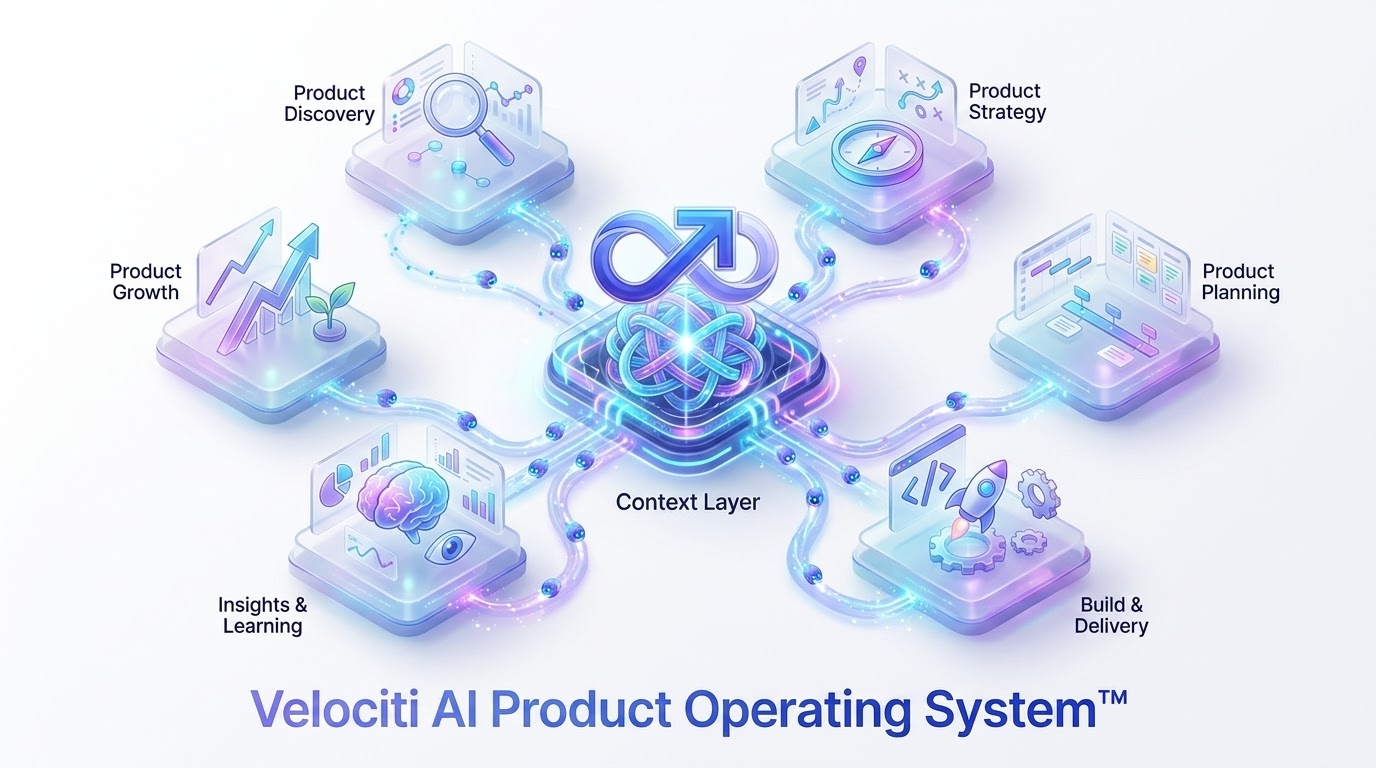
This is the gap Velociti was built to close, and it's the reason we call ourselves the AI Product Operating System, not another project management tool. Jira, Linear, and their peers were built to track the output of decisions someone already made. We built Velociti to generate, validate, and preserve the input, the context, the evidence, the reasoning, that makes those decisions correct in the first place.
The mechanism for using the continuously evolving Context Layer to build, is what we call the Context Loop: Discovery → Context → Strategy → Action, running continuously instead of once.
It starts with the Discovery Agent turning a single prompt or artifact into a full canvas (problem maps, personas, story maps, strategic themes) compressing what used to be weeks of workshops and parsing thousands of lines of data, into minutes. That output becomes your living context layer: not a PRD that goes stale the moment it's written, but a persistent, compounding system of record that every subsequent decision builds on instead of starting from scratch. From there, context becomes theme-based strategy, and strategy becomes execution-ready work, user stories, backlog tickets, prototypes, and Context Loops that trace back to the original problem and evidence every time an engineer, designer, or AI coding tool touches them.
The loop continues at the exact point most teams break: the handoff to AI-assisted execution. A Context Loop isn't a better prompt. It's the structured answer to the five questions every AI coder needs before it writes a line of code: what problem, for whom, in what terms, toward what measurable outcome, inside what constraints, so that speed becomes leverage instead of risk. One click, and it exports straight into Cursor, Claude Code, or whatever your team builds with. The context doesn't evaporate between sessions. It compounds with every sprint, the same way a real operating system compounds in value the longer it runs your business.
That's the moat. Not "we ship features faster." Every AI-native tool can say that now, and most of them are telling the truth. Ours is: we are consistently right about what to build, and we can prove it, sprint over sprint, because the evidence never gets lost.
Here's where the two fronts meet.
We could keep publishing this thesis quietly , one useful post at a time, optimizing for search, waiting for the category name to show up in someone else's pitch deck first. A year ago that would have been a defensible strategy. It isn't anymore, and a16z's own essay is the clearest explanation we've read for why.
The essay's argument is that the old model, build the product, find product-market fit, then bolt on distribution, is breaking, because product alone stops being defensible the moment anyone can build it. What replaces it is founders making the right people understand the right thing before the rest of the market does. And the crucial detail, the one most companies get backwards, is that new media "isn't really a type of content, it's a type of packaging," designed to surface what's already true and interesting, not to manufacture a story that isn't there.
We already have the true thing. We've had it for eighteen weeks of posts, before we had a name as clean as "AI Product Operating System" to put on it. What we haven't done, until this post, is package it as a category claim instead of a series of useful articles. That changes today.
So: Velociti is the AI Product Operating System. Not a claim we're making because it sounds good in a headline. A claim we're making because we've spent eighteen weeks showing our work, in public, on exactly the problem it describes. The Context Loop isn't a feature we bolted onto a PM tool. It's the reason the category needs a name at all.
None of this works as a single post. It works as a trail. The same "existence proof" idea a16z's team describes seeing with their own portfolio companies: small, compounding, dated proofs that a thesis holds up in practice, not just in an essay.
For us, that trail looks like founders shortening their path to product-market fit because they stress-tested the idea before writing code, not after. It looks like product leaders defending a roadmap with evidence instead of the loudest voice in the room. It's the quote already sitting on our homepage from a founder who put it better than we could: "Instead of starting from scratch every time, we build on accumulated intelligence." That's the Context Loop working exactly as intended, in someone else's words, which is worth more than a hundred of ours.
By the time a prospective customer, a future hire, or an investor sits down with us, we want the thesis to already feel familiar, because they read it here, saw it work for someone else, and are showing up to confirm a conviction that's already forming, not to hear the idea for the first time. That's the whole model, applied to ourselves: signal, then traction, then validation from other people, then conviction. We're not asking anyone to take our word for it. We're asking them to look at eighteen weeks of receipts and one very clear name for what they add up to.
Code was never the constraint. Context is. We built the operating system for it. And starting with this post, we're done being quiet about it.
Try Velociti: Run your first discovery sprint in minutes and turn it into a Context Loop your AI coder can build from today.
Questions? Reply directly to anthony@velocitipm.com
© 2026 Velociti · velocitipm.com · Discovery > Context > Strategy > Action
.png)
.png)