The AI Operating System for Product Organizations: A Strategic Playbook for Discovery, Context, Strategy, and Execution
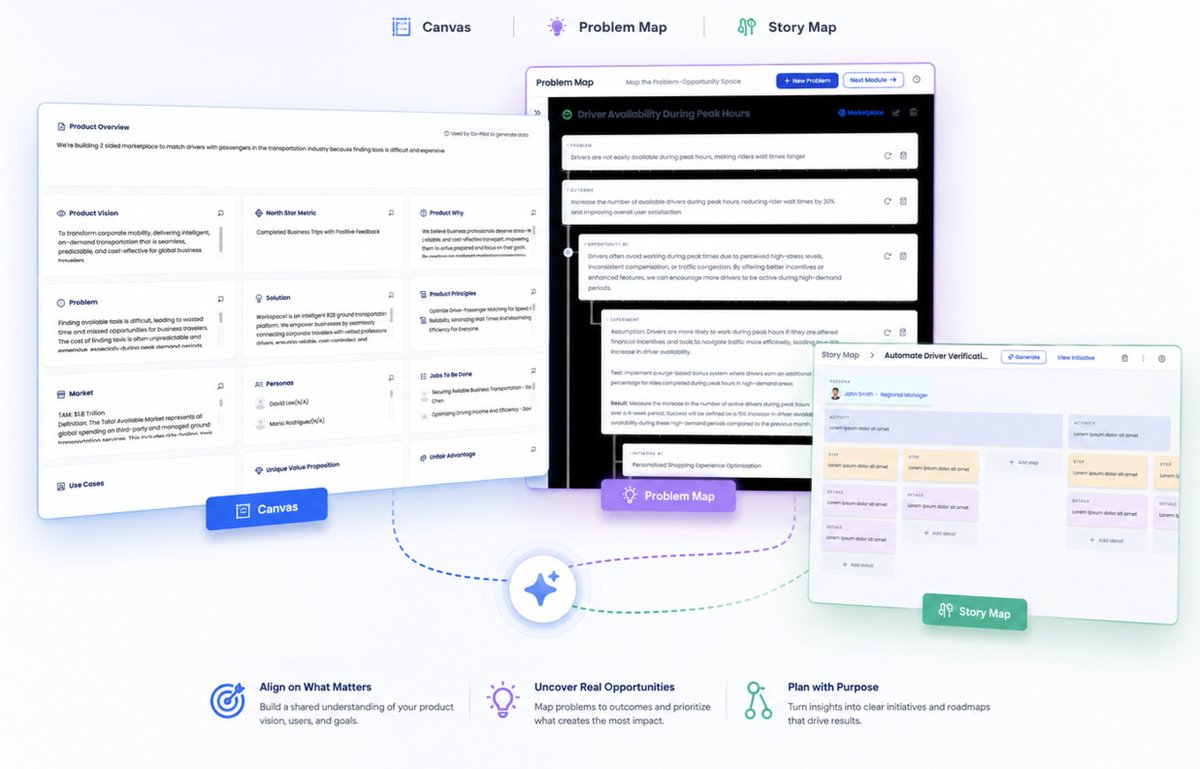
The modern product development lifecycle is suffering from a profound strategic misalignment. While the advent of AI-driven development and "vibe coding" has made the act of building software faster and cheaper than ever, the cognitive framework for deciding what to build remains trapped in an archaic, documentation-first paradigm. We have entered an era where execution capacity has scaled exponentially, yet decision-making quality remains linear and manual. This imbalance has shifted the primary bottleneck of innovation: code is no longer the constraint—context is.In most organizations, the Product Manager has been relegated to a documentation clerk, managing tool sprawl rather than market signals. Without a systematic shift, accelerated building simply results in "faster failure."
The current "Documentation-First" model has led to what we define as the "90% Delivery Trap." The economic impact of this discovery deficit is staggering:
Product leadership often mistakes shipping velocity for progress. However, increasing the speed of an unvalidated roadmap only compounds risk. When discovery is skipped or rushed, organizations fall victim to HiPPO-driven (Highest Paid Person's Opinion) decision-making and reactive prioritization. To mitigate this risk, the organization must transition from static documentation to an agent-driven architecture that establishes discovery as a continuous, automated baseline for every line of code written.
This architectural shift is the prerequisite for moving from manual documentation to a high-leverage, agent-driven system.
Moving from "Documentation-First" to "Agent-First" workflows represents the most significant organizational design shift since the adoption of Agile. Traditional tools were designed to store the output of human decisions; agents are designed to synthesize the inputs required to make them. This shift transforms the PM from a manual documenter into a high-leverage strategist who directs autonomous agents to validate intent and maintain context in real-time.
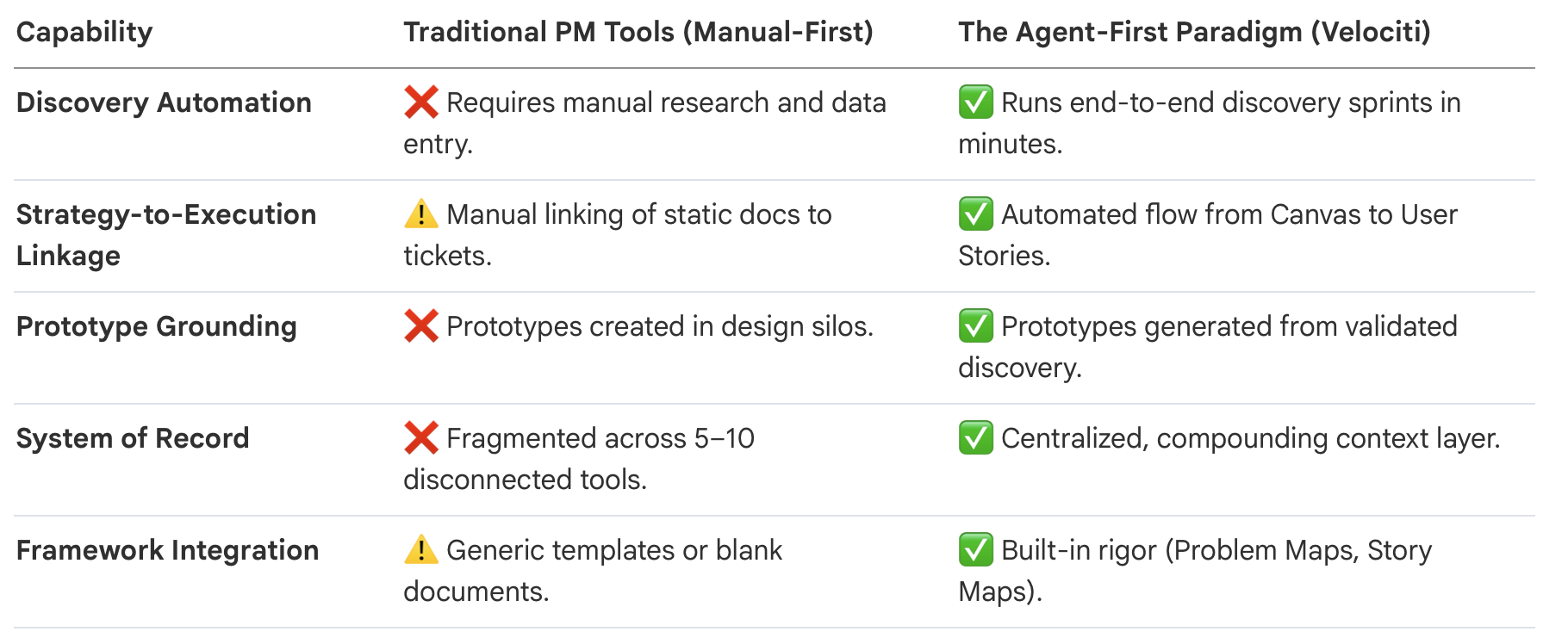
As execution becomes a commodity, the value of the "System of Record" for product intent grows. Traditional fragmented ecosystems fail because they cannot maintain a persistent memory of why decisions were made. Knowledge is leaked through Slack threads and Miro boards, creating "context collapse" at the point of execution. An agent-first architecture solves this by creating a "Living Context Layer"—a compounding asset that ensures every strategic decision is rooted in evidence rather than intuition.
This shift is operationalized through a unified, four-stage workflow: Discovery > Context > Strategy > Action.
Strategic excellence requires the elimination of the "handoff gap." By connecting these four pillars into a unified workflow, organizations ensure that every line of code is traceable to a validated customer problem, effectively ending the era of ungrounded building.
The most critical output of this workflow is the elimination of the handoff gap through the deployment of grounded prototyping.
A primary risk in AI-driven development is the generation of "ungrounded" output—code or designs that appear functional but solve the wrong problem. "Grounded Prototyping" ensures that AI-generated artifacts are rooted in the validated discovery and strategic intent stored in the context layer.
Velociti bridges the gap between "thinking" and "building" by generating user stories and web app prototypes directly from the context layer. This ensures that the execution phase is not merely fast, but inherently aligned with the validated customer need. By moving from a prompt directly to a grounded prototype, the team eliminates the ambiguity that typically plagues the handoff from Product to Engineering.
For cross-functional teams, this model treats discovery as a risk-mitigation strategy rather than a "black box" process:
The strategic imperative for the modern executive is to move from measuring "shipping velocity" to measuring "capital efficiency." In an agent-first organization, the goal is not to build more, but to build precisely. The reduction of waste is the ultimate driver of product ROI.
An agent-first organization creates a "compounding context layer." Unlike traditional tools that become cluttered and lose value over time, a context-driven system becomes more valuable with every discovery sprint. This creates a long-term strategic advantage: the system effectively "learns" the product strategy, customer patterns, and historical outcomes, making every subsequent decision more accurate than the last.
Final Call to Action The future of the product category will not be dominated by those who build the fastest, but by those who are most consistently right about what to build. By transitioning to an Agent-First Product Organization, teams can finally exit the 90% Delivery Trap, eliminate the crisis of context scarcity, and start delivering products that matter.
.png)
.png)