
Learn what a product roadmap is, what it includes, and why it matters. Use this beginner’s guide to align teams and plan smarter—read now.
.png)
A product roadmap is a visual plan that shows where a product is going, what the team wants to achieve, and which priorities should come first. It helps product managers connect customer needs, business goals, and product development in one clear view. A roadmap is not simply a list of features. It provides context behind product decisions and helps teams understand why specific initiatives matter. Effective roadmap planning also gives product, engineering, design, marketing, and sales teams a shared direction.
For growing product teams, having this shared direction becomes even more important. New customer requests, business goals, market changes, and technical challenges can all affect priorities. A roadmap helps product managers organize these factors and make better decisions.
A product roadmap is a strategic plan that communicates the direction of a product over time. It gives product managers a high-level way to present goals, initiatives, priorities, and expected outcomes to stakeholders. Unlike a project task list, a roadmap does not need to include every development activity. Instead, it focuses on the bigger picture. This allows product, engineering, design, marketing, sales, and leadership teams to understand what the product team wants to achieve. Product managers can also use a product roadmap tool to organize strategic priorities, initiatives, and expected outcomes in one place.
The exact information depends on the product and organization. However, most roadmaps show major priorities, strategic initiatives, important features, broad timeframes, and expected outcomes. Some roadmaps also include milestones, dependencies, or risks. The goal is to provide enough information for stakeholders to understand the direction without making the roadmap too complicated.
A product roadmap helps teams work toward common goals. Without a shared plan, teams can easily become focused on individual feature requests rather than larger product objectives. Product planning software for startups can help connect product goals with the work needed to achieve them. For product managers, a roadmap provides a framework for discussing priorities with stakeholders. It helps explain why one initiative may be more important than another and why certain ideas may need to wait.
A clear roadmap helps product managers align teams, communicate priorities, evaluate trade-offs, and connect customer problems with product decisions. For example, if customer retention is a major goal, the product team can prioritize initiatives that address the reasons customers leave. This approach is more strategic than adding unrelated features simply because different stakeholders requested them.
A good roadmap should answer three basic questions: Where is the product going? What will the team focus on? Why does that work matter? The answers should be simple enough for stakeholders to understand quickly. A roadmap does not need to contain every product detail. Too much information can make it harder to identify the most important priorities.
The level of detail should also match the audience. Executives may need a high-level view, while engineering and product teams may require more context about initiatives and dependencies.
A useful roadmap normally includes a product vision, goals, initiatives, features, broad timeframes, and expected outcomes. The vision describes the long-term direction. Goals explain what the team wants to achieve. Initiatives represent larger areas of work, while features describe specific product improvements.
Expected outcomes are also important because they explain the value behind the work. This helps keep the roadmap focused on results rather than simply measuring progress by the number of features delivered.
Creating a product roadmap starts with understanding the product strategy. Product managers should know what they want the product to achieve before deciding which features or initiatives should be included. Once the direction is clear, the team can gather customer insights, identify opportunities, prioritize important work, and organize those priorities into a roadmap.
A strong process also leaves room for change. Product managers should not treat the roadmap as a permanent plan because customer needs, market conditions, and business priorities can change.
The product vision describes the future the team wants to create for customers. It provides direction for product decisions and helps everyone understand the larger purpose behind the product. Start by identifying the problem the product solves, the customers it serves, and the value it should provide. These answers can guide future roadmap decisions and help the team avoid unrelated work.
After defining the vision, establish clear product goals. These goals should focus on meaningful outcomes instead of simply listing features. For example, “increase user activation” describes a desired result, while “create a new onboarding screen” describes one possible solution. Focusing on outcomes gives product teams more flexibility when deciding how to solve a problem.
Customer feedback should influence roadmap decisions. Product managers can learn from interviews, surveys, support conversations, sales feedback, product data, and other research. However, not every request should automatically become a roadmap item. Look for repeated problems and patterns. If many customers experience the same issue, it may represent a larger opportunity.
Product teams have limited time and resources, so they cannot build everything at once. Prioritization helps determine which opportunities deserve attention first. Consider customer impact, business value, effort, risk, urgency, and strategic fit. Making the reasoning clear also helps stakeholders understand why some initiatives receive higher priority.
There is no single roadmap format that works for every product team. The best format depends on the product, organization, planning process, and audience. Some teams need a simple view of current and future priorities. Others need a broader timeline showing major initiatives. Customer-facing teams may also need a simplified version that communicates product direction without exposing internal details.
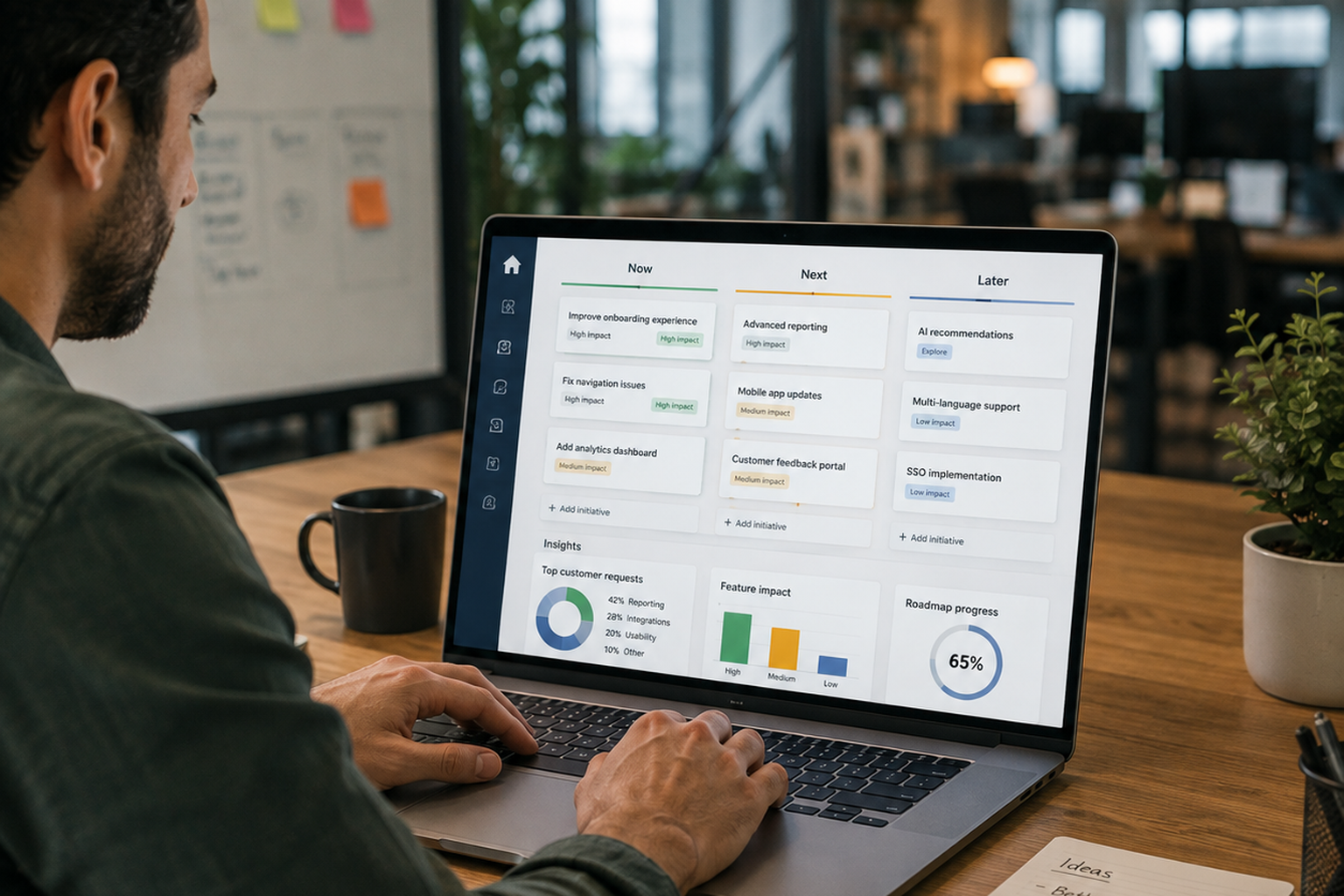
Popular formats include now-next-later, timeline, goal-based, feature, and release roadmaps. A now-next-later roadmap groups work by current and future priorities. A timeline roadmap organizes initiatives across broad periods. A goal-based roadmap connects planned work with specific outcomes. The most useful format is the one that makes priorities easy to understand. A complicated roadmap does not automatically provide more value.
A product roadmap and product backlog are related, but they serve different purposes. The roadmap communicates strategic direction, while the backlog contains more detailed work needed for execution. A product delivery planning tool can help teams move from high-level roadmap priorities toward more detailed execution. The roadmap shows where the product is going and which major areas deserve attention. The backlog may contain user stories, bugs, technical tasks, requirements, and other development items.
As product teams grow, managing plans through spreadsheets, presentations, and separate documents can become difficult. Roadmap software provides a central place to organize priorities, communicate plans, and maintain visibility. A useful platform can also help connect product strategy with initiatives and execution. This allows teams to see how planned work supports larger goals. VelocitiPM provides an AI product management environment designed to connect product context, initiatives, priorities, and execution. For teams looking to create a more connected workflow, a centralized product management platform can simplify planning and collaboration.
When choosing roadmap software, consider whether it supports the way your team works. Useful capabilities may include flexible roadmap views, initiative tracking, collaboration, prioritization, progress tracking, and connections between strategy and execution. The right tool depends on the team's size and needs. A small team may prefer a simple planning environment, while larger organizations may need stronger collaboration and visibility across teams.
A roadmap can lose its value when it becomes too rigid or focuses only on features. One common mistake is treating the roadmap as a fixed promise that every item will be delivered exactly as shown. Product environments change constantly. New customer feedback, technical limitations, market conditions, and business priorities can affect planned work. Another mistake is adding every stakeholder request. A roadmap should reflect product strategy rather than becoming a list of everything different teams want.
Avoid making the roadmap too detailed, treating estimated dates as fixed commitments, prioritizing features without understanding the problem, and adding initiatives without connecting them to meaningful goals. Product managers should also communicate changes clearly. When priorities shift, stakeholders should understand what changed and why. A good roadmap creates clarity. If it becomes difficult to understand or maintain, its structure may need to be simplified.
A product roadmap should be reviewed regularly, but it does not need to change every day. The right review cycle depends on the product, market, team, and level of uncertainty. Fast-moving products may require more frequent reviews. Products with longer planning cycles may need fewer changes. The important thing is to update the roadmap when new information affects product decisions. Customer feedback, product data, market changes, business goals, and technical discoveries can all influence future priorities.
Review the roadmap when customer needs change, a major business goal shifts, new opportunities appear, product data challenges an assumption, or an initiative no longer provides enough value. Technical dependencies can also affect the plan. Regular reviews keep the roadmap useful while allowing product teams to respond to new information.
A product roadmap gives product managers a clear way to communicate product direction, priorities, and goals. It connects customer needs with business objectives and helps teams understand which initiatives deserve attention. The best roadmap is not necessarily the most detailed one. It should provide enough information to guide decisions while remaining flexible as the product evolves. Ready to simplify your product planning and keep your team aligned? Explore VelocitiPM today and see how you can bring your product strategy, roadmap, and execution together in one place.
Yes. A roadmap should change when customer needs, data, market conditions, or business priorities change.
The product manager usually owns the roadmap while working with engineering, design, sales, marketing, and leadership teams.
Not always. Broad timeframes can provide direction without creating rigid delivery commitments.
Product strategy explains the direction and reasoning, while the roadmap shows the major work supporting that direction.
Yes. It can help small teams organize priorities, communicate plans, and keep product work aligned.
.png)
.png)