
An AI feature prioritization framework helps product teams evaluate customer value, business impact, technical feasibility, data readiness, and effort to identify the right features to build first. By combining structured criteria with AI-assisted analysis, teams can make faster roadmap decisions, reduce wasted development effort, and focus resources on features with stronger potential value
.png)
An AI feature prioritization framework helps product teams evaluate feature ideas based on customer needs, business impact, strategic alignment, development effort, and available product context. By combining structured prioritization with AI-powered analysis, teams can identify high-value opportunities faster, reduce subjective decisions, and focus limited development resources on features that can create meaningful customer and business value.
For modern product teams, deciding what to build can be harder than building it. Customer requests arrive from different channels, stakeholders have competing priorities, competitors introduce new capabilities, and engineering capacity is never unlimited. VelocitiPM helps product teams bring discovery, strategy, planning, and execution together with an AI product management platform. As AI makes it easier to generate product ideas, prototypes, and possible solutions, the challenge is no longer creating enough ideas. It is deciding which ideas deserve investment and which should wait.
Most product teams have more potential features than they can realistically build. Some solve major customer problems, while others address relatively small requests. A feature may look attractive from a business perspective but require significant development, maintenance, and support. Without a clear prioritization process, teams can become reactive. A request from an important customer may jump to the top of the roadmap. A stakeholder may push an idea because it sounds promising, or a competitor's launch may influence the product direction. Over time, this can create a roadmap full of activity without a strong connection to product strategy.
Effective prioritization gives product managers a consistent way to compare opportunities and determine where limited resources should be invested. AI can make that process faster by organizing information, identifying patterns, summarizing feedback, and supporting comparisons between potential features.
An AI feature prioritization framework combines traditional product prioritization methods with artificial intelligence to assess and rank potential product features. The process should not simply involve asking AI which feature the team should build. AI needs relevant context to provide useful recommendations. Customer problems, business goals, user research, product strategy, existing features, technical constraints, and available resources can all influence the right decision.
A strong framework connects individual feature ideas to broader product strategy. This helps teams understand not only what customers are requesting, but also why a feature matters and what outcome it could support.
A practical prioritization framework can evaluate customer value, business impact, strategic alignment, effort, complexity, and confidence. Customer value measures how effectively a feature addresses a genuine problem. Business impact considers potential effects on revenue, retention, adoption, or differentiation. Strategic alignment shows whether the opportunity supports the product's current direction.
Effort and complexity consider the resources required to build and maintain the feature. Confidence reflects how much evidence supports the assumptions behind the opportunity. AI can help organize these factors and create a consistent starting point for evaluation.
Traditional prioritization can involve meetings, spreadsheets, research reviews, customer feedback analysis, and stakeholder discussions. The process becomes increasingly time-consuming as the backlog grows. AI can reduce some of this manual work. A product team may have hundreds of feedback entries across surveys, support conversations, interviews, and feature requests. Reviewing every response manually can make it difficult to identify larger patterns.
AI can summarize this information and group similar feedback into recurring themes. Product managers can then connect those themes to potential initiatives and evaluate them against strategic priorities. This allows teams to spend more time interpreting evidence and less time organizing it. The goal is not to let AI make the final decision. AI works best as an analytical assistant that helps product managers work with information more efficiently.
Customer feedback is valuable, but individual requests do not always reveal the larger problem. One customer might request a specific feature, while another describes a different experience caused by the same underlying issue.
AI can help group related feedback and surface common themes. Instead of treating dozens of requests as separate opportunities, teams may discover that many point toward one larger customer problem. For teams looking to organize discovery and validate customer problems more effectively, a product discovery platform can help connect customer insights with the broader product decision-making process.
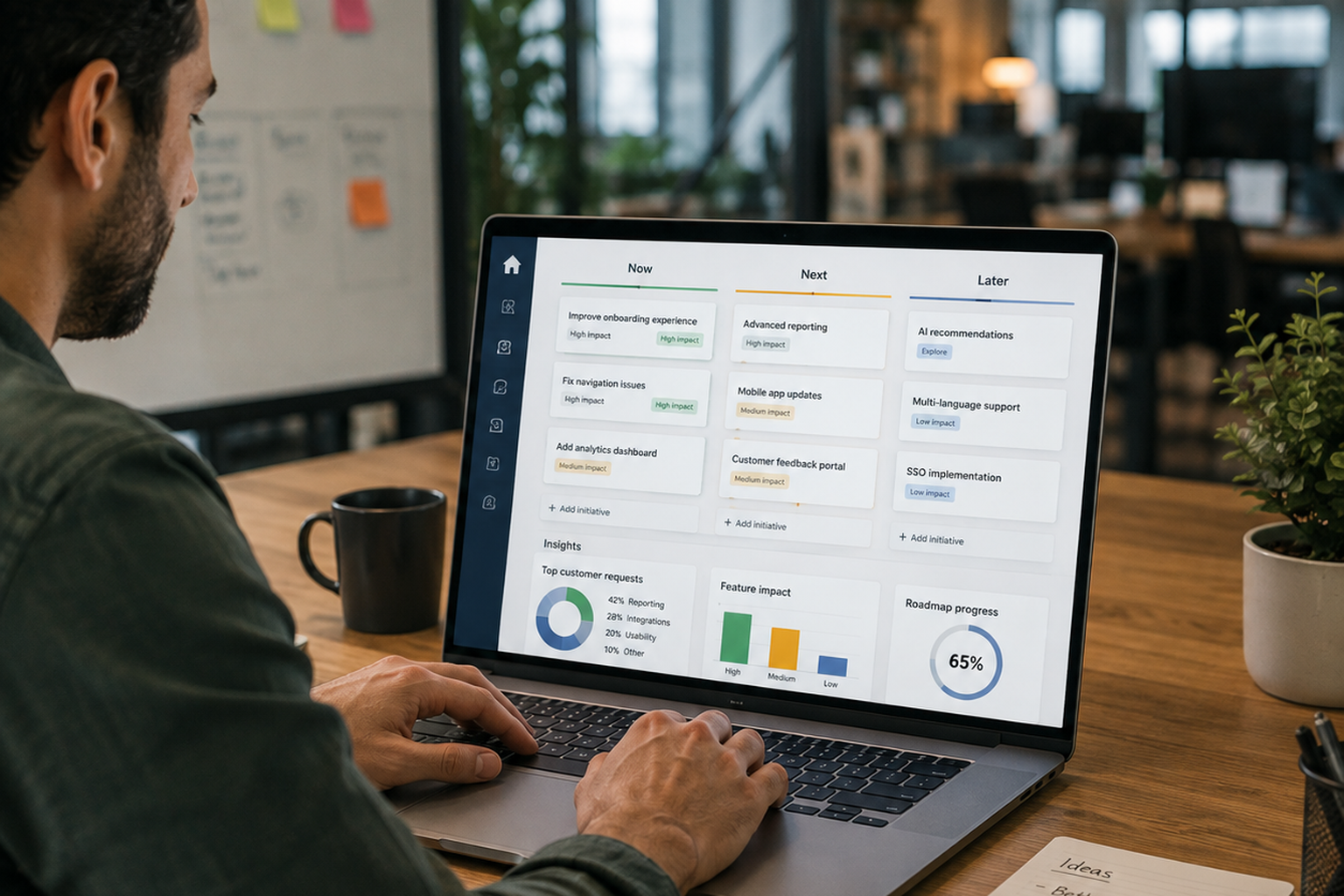
A feature prioritization matrix helps teams compare opportunities using predefined criteria. A common approach is to assess potential impact against development effort. Features with high potential value and relatively low effort may receive greater priority than features requiring substantial investment for limited impact. However, impact and effort should not be the only considerations.
AI can make the matrix more useful by helping teams collect and summarize the evidence behind each opportunity. Product managers can review the assessment, challenge assumptions, and adjust the evaluation based on their knowledge. The matrix should not reduce every product decision to one score. A feature could have strong customer demand but weak strategic alignment. Another might have moderate demand while supporting a major business objective. AI can highlight these tradeoffs so teams can make more informed decisions.
Feature prioritization works best when connected to both strategy and execution. A product strategy framework defines where a product is going and why. It connects customer problems with business objectives and establishes the outcomes the product team wants to achieve.
Once strategic priorities are clear, individual opportunities can be evaluated against them. This creates a natural connection with a product execution framework. Customer problems inform discovery, discovery creates opportunities, strategy helps evaluate those opportunities, and prioritized initiatives move into planning and execution. Results from execution can then provide new information that influences future prioritization. AI becomes especially valuable when it can support this complete chain rather than working only with an isolated feature list.
Prioritization is especially important for startups because teams typically have limited people, time, and development resources. Product Planning for Startups often involves making decisions with incomplete information. A startup may have dozens of potential ideas but enough capacity to build only a few. An AI-assisted process can help teams organize customer insights, compare opportunities, and identify gaps in their reasoning.
For example, a startup could evaluate a feature based on customer pain, business value, strategic importance, development effort, and evidence from early users. AI can structure that information and identify areas where additional validation may be needed. However, startup teams should not treat AI recommendations as unquestionable answers. Early-stage products often have limited data, so human judgment and direct customer conversations remain essential.
AI can process product information quickly, including research, analytics, goals, roadmap items, and engineering constraints. An AI product development platform can connect these inputs so AI has better context when supporting decisions. The goal is to improve decision speed and consistency while keeping product managers responsible for the final call.
Teams should review AI recommendations before they influence the roadmap. Check whether the recommendation supports product strategy, solves a real customer problem, has realistic benefits, and fits available resources. AI can analyze information quickly, but human judgment remains essential.
VelocitiPM presents itself as an AI Product Operating System connecting discovery, strategy, planning, and execution in one workflow. Its Velo AI capabilities can generate artifacts such as canvases, problem maps, story maps, and initiatives from prompts or existing artifacts. This supports prioritization because teams can consider the customer problem, strategy, and execution requirements behind an opportunity.
Start by collecting customer feedback, research, business goals, analytics, strategy, and existing initiatives. Define criteria such as customer value, business impact, strategic alignment, confidence, and effort. Use AI to organize the information and create an initial assessment.
Review recommendations with the team, challenge assumptions, add missing context, and adjust evaluations. Then move the strongest opportunities into execution. A repeatable process keeps prioritization evidence-based.
An AI feature prioritization framework helps teams evaluate features faster while keeping decisions connected to customer needs, business goals, and product strategy. AI should support product managers, not replace them. With structured evaluation and reliable evidence, teams can reduce wasted effort and focus on opportunities with meaningful potential.
VelocitiPM offers a connected AI-powered environment for teams that want discovery, strategy, planning, and execution in one workflow. Ready to make smarter product decisions and prioritize the features that matter most? Explore VelocitiPM and see how AI-powered product management can help your team turn product insights into focused action. This keeps AI useful without removing accountability.
It uses AI and structured criteria to evaluate and rank potential product features.
No. Product managers still provide strategic judgment and customer understanding.
It compares features using factors such as impact, effort, value, and strategic importance.
AI can organize feedback, identify patterns, summarize research, and compare opportunities faster.
Relevant context helps AI provide recommendations that better reflect customer and business needs.
.png)
.png)