No, AI will not replace product managers in 2026. It will support and enhance their role by automating routine tasks and improving decision-making.
Will AI replace product managers is one of the most debated questions in the future of product management. With rapid advancements in tools like ChatGPT and analytics platforms such as Amplitude, the role of product managers is evolving quickly. Platforms like Velociti are also accelerating product workflows, helping teams move faster and make smarter decisions.
Some professionals believe AI will take over core responsibilities. Others argue that AI will empower product managers to own the entire product development life cycle. This article explores both perspectives and explains what lies ahead.
AI is already automating many traditional product management tasks. For example, tools can generate product requirement documents, analyze user behavior, and even suggest feature priorities.
In addition, AI workflows reduce manual effort. Platforms like Notion AI can draft documentation in seconds. This shift raises a valid concern. If AI handles execution, do companies still need product managers?
Moreover, startups are adopting lean teams. In some cases, founders rely heavily on AI tools instead of hiring full product teams. This trend strengthens the argument that AI could replace certain PM functions.
Despite automation, product managers bring skills that AI cannot replicate. Human judgment remains critical when making strategic decisions. AI can provide insights, often through an ai product discovery tool, but it cannot fully understand context, emotions, or stakeholder expectations.
Furthermore, product managers act as a bridge between teams. They align engineering, design, and business goals. This requires communication and leadership skills that AI cannot replace.
Therefore, while AI can assist, it cannot fully take over the role.
The product development life cycle includes several stages. These stages define how a product moves from idea to launch and beyond.
Traditionally, product managers oversee each stage. They ensure smooth collaboration and guide decision making.
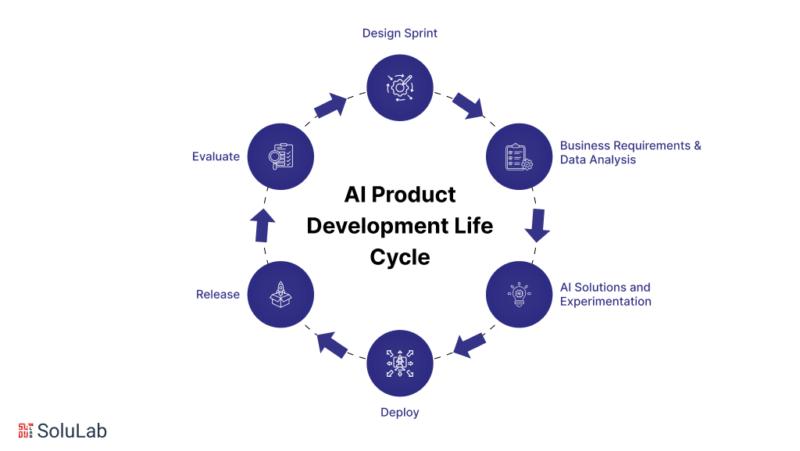
AI is not replacing product managers. Instead, it is reshaping how they work across the PDLC.
AI tools analyze trends and customer feedback quickly. For example, machine learning models can identify gaps in the market. As a result, product managers can validate ideas faster.
AI can suggest roadmaps based on data. It can also predict feature impact. This helps product managers prioritize tasks more effectively.
During development, AI improves communication between teams. Documentation tools generate user stories automatically. This reduces time spent on repetitive tasks.
AI can detect bugs and generate test cases. It also predicts potential failures. Therefore, teams can release more stable products.
After launch, AI tools track user behavior. Platforms like Google Analytics provide real-time insights. Product managers can then optimize features based on data.
AI is changing the role of product managers significantly.
In the past, product managers handled multiple operational tasks. Now, AI takes over execution. As a result, product managers focus more on strategy.
They become orchestrators who manage tools, teams, and workflows.
AI enables product managers to handle more responsibilities. With automation, one PM can oversee the entire product life cycle.
This shift increases ownership and accountability.
To stay relevant, product managers must adapt.
Product managers do not need to code. However, they must understand how AI systems work. This helps them use tools effectively.
AI generates large amounts of data. Product managers must interpret this data to make decisions.
AI handles execution. Therefore, product managers must focus on problem solving and long term strategy.
Human skills remain essential. Product managers must align teams and manage stakeholders.
While AI offers many benefits, it also has limitations.
AI models depend on data. If the data is biased, the output will also be biased.
Too much reliance on AI can reduce critical thinking. Product managers must validate AI insights.
AI cannot fully understand human emotions or business nuances. This limits its decision making ability.
AI raises ethical issues related to data privacy and transparency. Product managers must address these challenges.
Many companies are already using AI to improve workflows.
Startups use AI to validate ideas quickly. They analyze customer feedback and build prototypes faster.
Large enterprises use AI for analytics and forecasting. This helps them scale products efficiently.
In addition, solo product managers are managing entire products using AI tools. This shows how AI is expanding the scope of the role.
The future of product management will be shaped by AI adoption.
Companies may hire fewer product managers. However, they will expect higher skill levels.
New roles will focus on AI integration. Examples include AI product managers and product operations specialists.
Product managers will combine skills from data, design, and business. This will make them more versatile.
Will AI replace product managers is not a simple yes or no question. AI is transforming the role, not eliminating it.
Product managers who adapt will gain more control over the entire product development life cycle. They will move from execution to strategy and leadership.
On the other hand, those who resist change may struggle to stay relevant.
The future belongs to product managers who embrace AI, learn new skills, and evolve with technology. If you want to explore how AI can enhance your product workflows, feel free to visit our Contact Us page and connect with our team.
No, AI will not fully replace product managers. It will automate tasks but cannot replace human judgment and leadership.
The future of product management involves AI integration, strategic thinking, and cross functional skills.
Yes, product managers should understand AI basics. This helps them use tools effectively and make better decisions.
AI can assist in creating roadmaps. However, product managers must validate and adjust them based on business goals.
They should focus on data literacy, strategy, and communication. In addition, they should adopt AI tools in their workflows.
.png)
.png)