AI coding tools build fast. But the output is only as good as what you put in front of them. Here's why most teams have upgraded their build layer without upgrading their context layer — and what to do about it.
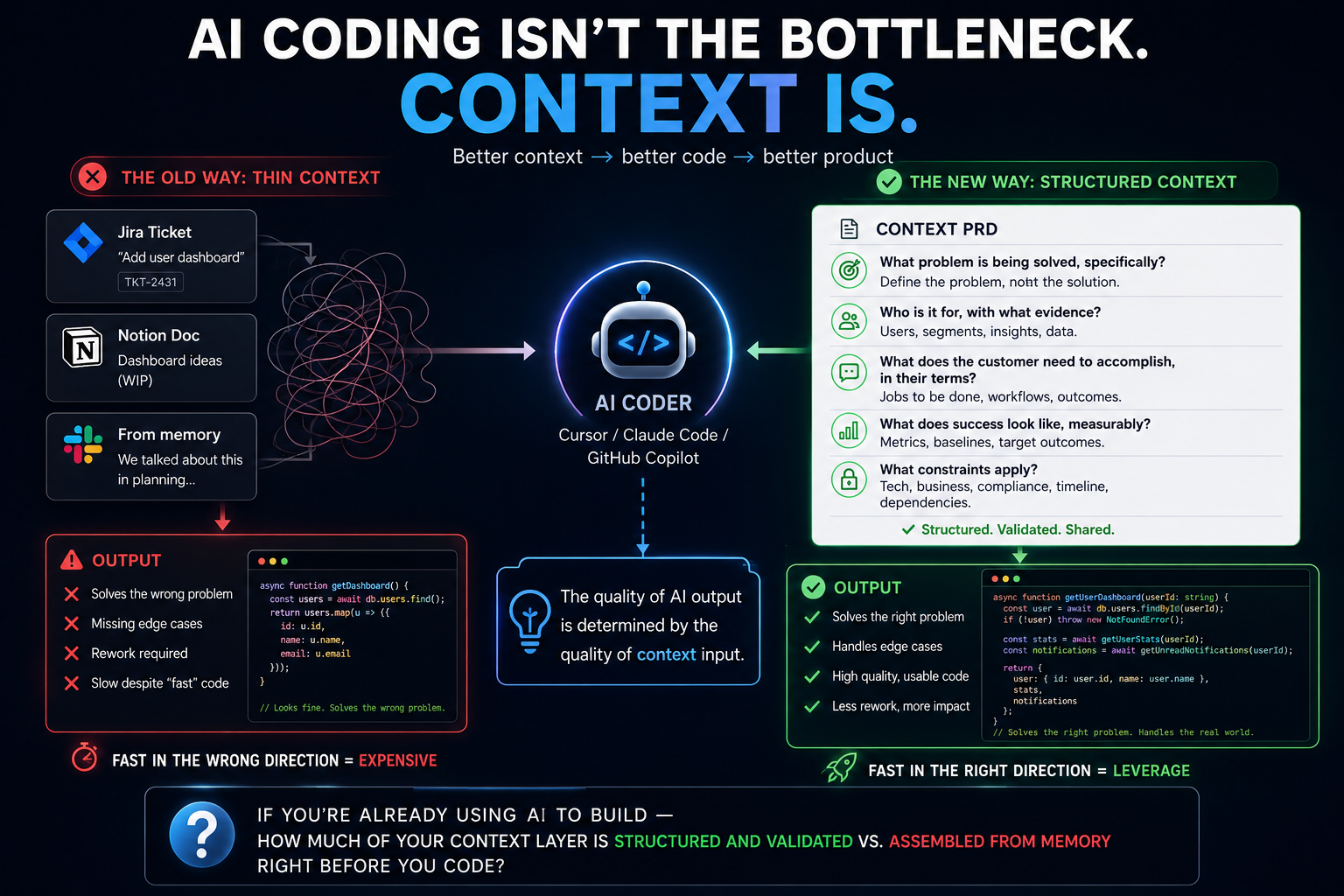
AI coding tools have made building software dramatically faster. But speed without direction is just expensive failure at higher velocity. This post is about the gap most teams haven't fixed — and the one change that closes it.
The build layer got faster. The context layer didn't.
If you're using Cursor, Claude Code, or GitHub Copilot, you've seen what these tools can do. The code comes out fast. Sometimes frighteningly fast. A feature that used to take a sprint takes an afternoon. A prototype that used to require a designer and two engineers can now exist by end of day.
And if you're honest with yourself, you've also noticed something else.
The output is only as good as what you put in front of it.
Give Cursor a vague prompt and you get vague code. Give it a feature description without the problem context and you get something technically functional that solves the wrong problem. Give it a PRD written from memory and the business logic of what it generates reflects the gaps in what you gave it.
The AI is not the bottleneck. Your context is.
The thin context problem
Most teams using AI coding tools are still operating with the same thin context layer they've always had.
• A Jira ticket with a title and three acceptance criteria
• A Notion doc someone wrote six weeks ago that may or may not reflect current thinking
• A Slack thread where the decision got made but the reasoning evaporated
• Someone's memory of what was discussed in the last planning meeting
They've upgraded the build layer. They haven't upgraded the context layer. And then they wonder why the AI output needs so much rework — why the generated code is technically correct but somehow off, why the prototype looks right but behaves wrong, why the feature ships and users don't use it the way anyone expected.
The rework isn't a code quality problem. It's a context quality problem. The AI built exactly what it was told to build. The problem is that what it was told wasn't grounded in what actually needed to be built.
What good context actually looks like
Here's the shift: treat the context you give your AI coder as a product artifact in itself. One that's structured, validated, and maintained with the same rigor you'd bring to your architecture decisions or your data model.
Good context answers five questions before a line of code gets written:
1. What problem is being solved, specifically?
Not "users want a faster onboarding." The specific situation: who the user is, what they're trying to accomplish, what's blocking them, and what it costs them — in time, money, or frustration — when they can't solve it. This is the most important input your AI coder receives. Without it, every design decision the AI makes is a guess dressed up as a specification.
2. Who is it for, with what evidence?
A persona isn't a demographic. It's a specific, evidence-based profile of a real type of user — their context, their constraints, the mental models they bring to the problem. When the AI hits an implementation decision the spec doesn't cover (and it will), it can reason from the persona rather than making a random call. Without it, edge cases get resolved arbitrarily.
3. What does the customer need to accomplish, in their terms?
This is the Jobs To Be Done question. Not what feature did they request — what progress are they trying to make in their life or work? What does success look like from their perspective, not yours? This grounds every downstream decision in the customer's actual motivation rather than a feature specification. It's the difference between building something that works and building something people actually use.
4. What does success look like, measurably?
The outcome this initiative is designed to drive. A specific, measurable change in customer behavior. Not "improve onboarding" — "increase the percentage of users who complete setup in their first session from 40% to 60%." Without this, AI optimizes for the spec. With it, AI can make micro-decisions that serve the outcome rather than just completing the task.
5. What constraints apply?
What the product must do. What it must not do. What technical, business, or regulatory boundaries exist. The bounded space inside which the AI operates — so it's not making constraint assumptions that contradict your architecture, your compliance requirements, or your business model.
That's not a prompt. That's a Context PRD.
A Context PRD is the structured, permanent, continuously evolving context layer that sits between your product thinking and your AI coder — connecting them for the first time.
Not a doc. Not a prompt. Not someone's memory of last week's planning meeting.
A living artifact that every PM, engineer, designer, and AI tool works from simultaneously.
Why this matters more now than it ever has
Two years ago, the cost of thin context was painful but survivable. Your build cycle was long enough that the wrong direction became visible before too much was wasted. You'd ship something, learn it missed, and course-correct in the next sprint. The feedback loop was tight enough.
AI coding tools have compressed that cycle dramatically. A team that used to take a quarter to ship a feature now takes a week. And a team that takes a week can ship a wrong thing four times in the time it used to ship one wrong thing once.
AI made building faster. It didn't make knowing what to build easier.
The teams winning with AI right now are not the ones who ship the fastest. They're the ones who answer the hard questions before the coding session starts — and hand validated, structured context to the AI so it can use its speed as an advantage rather than a risk amplifier.
The compounding advantage
Here's what changes when you treat context as a product artifact:
• Your AI coder generates from validated direction, not vibes. The output quality improves not because the AI got smarter, but because the input got better.
• Rework decreases. Most AI coding rework is context rework — the generated code is correct for the wrong thing. Better context means fewer corrections.
• Every sprint builds on the last. When your context layer is permanent and evolving rather than assembled from memory before each session, you compound your understanding of the problem with every initiative you run.
• The whole team aligns. PM, engineer, designer, and AI coder all working from the same source of truth means decisions get made in the same direction without requiring constant re-explanation.
How Velociti closes the gap
Velociti is the operating system for product teams who own the context layer.
From a single prompt, Velociti's discovery agent runs a complete discovery sprint — Canvas, Problem Maps, Personas, Story Maps, and Strategic Outcomes — and structures the output into a permanent Context PRD. One click exports it directly into Cursor, Claude Code, or any AI coding tool of your choice.
The context layer doesn't evaporate between sessions. It doesn't live in someone's memory or a doc nobody bookmarked. It compounds with every sprint, every customer insight, every new initiative — becoming more precise, more validated, and more useful to every person and tool that works from it.
Discovery → Context → Strategy → Action. The complete loop. The gap between AI coding speed and product thinking, closed.
The question worth asking before your next coding session
How much of the context your AI coder is currently working from is structured and validated — versus assembled from memory right before the session starts?
If the honest answer is "mostly memory," you've upgraded your build layer without upgrading the context layer. The AI will build fast. The question is whether it'll build right.
That's the gap. And it's the one that compounds most expensively in a world where building fast is no longer the competitive advantage.
Knowing what to build is.
Try Velociti
Run your first discovery sprint in minutes and generate a Context PRD for your AI coder.
velocitipm.com
Questions? Reply directly — anthony@velocitipm.com
© 2026 Velociti · velocitipm.com · Discovery > Context > Strategy > Action
.png)
.png)